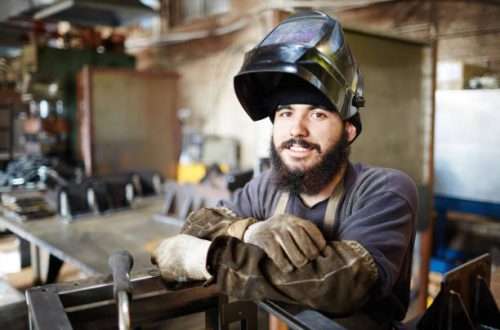
the welding helmet is almost a history of the evolution of welding safety technology. From the earliest handheld masks to today’s high-tech equipment with automatic dimming, ventilation, and intelligent monitoring functions, the welder’s protective experience has undergone a tremendous leap forward. This change is not only an innovation in materials and functions, but also reflects the people’s deep concern for occupational health, safety, and efficiency.
Early protection concepts
In the early days of welding, workers often used handheld black glass masks as a protective tool. While this design provided sufficient protection against strong sunlight, it had significant drawbacks: welders could not simultaneously operate and observe, requiring frequent lowering and raising of the mask. This not only reduced efficiency but also increased the risk of misoperation. As welding became more common, head-mounted welding helmets gradually emerged, freeing up hands but still requiring manual adjustment of the field of view.

The emergence of automatic dimming technology
At the end of the last century, the application of auto-dimming technology marked a crucial evolution in welding helmets . The addition of liquid crystal filters and light sensors enabled the helmet to automatically dim at the moment of arc light, protecting the eyes while maintaining a consistent workflow. This mature technology allowed welders to focus more fully on the welding process, significantly improving safety and efficiency.
The rise of intelligent design
In the era of intelligent manufacturing, welding helmets are no longer limited to passive protection. Some high-end helmets now incorporate air purification systems, Bluetooth communication, temperature monitoring, and operational data logging modules. Intelligent sensors can automatically adjust the darkness level based on ambient brightness and even monitor air quality in real time, helping welders mitigate the risk of fume inhalation. Some models also support integration with workbench systems, enabling data synchronization and optimization of welding parameters, achieving a higher level of human-machine collaboration.
Advances in comfort and ergonomics
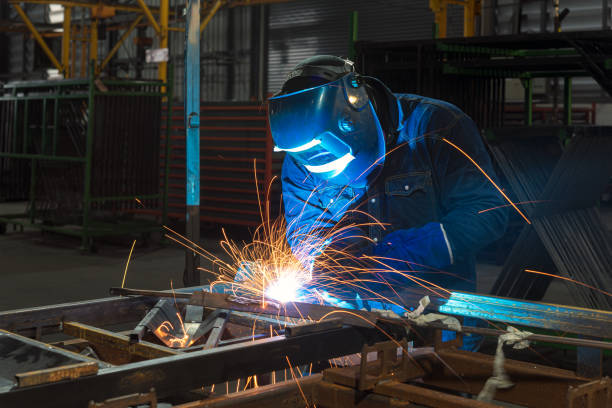
With updated design concepts, welding helmets no longer emphasize protection alone but instead prioritize user experience. Lightweight materials, flexible headbands, and adjustable balance structures allow for a more precise fit and reduce neck strain. The field of view of the lens has also gradually expanded, from the early narrow window to today’s panoramic viewing area. This allows welders to more accurately assess weld seam location and weld pool changes, significantly improving operational precision.
Future Trend Outlook
The future of welding helmets will be even more intelligent and personalized. The combination of artificial intelligence and sensing technology may allow helmets to automatically adjust the field of view brightness based on the welder’s habits. The addition of augmented reality technology also promises to overlay welding process instructions and parameters in real time. In that future, helmets will no longer be just protective gear, but rather the interface between the welder and intelligent systems.
Conclusion
From black glass visors to intelligent sensing systems, the evolution of welding helmet design represents a technological leap forward in industrial safety. It not only enables welders to work more safely and efficiently, but also signals the welding industry’s continued progress toward digitalization and intelligence. For every welder, a suitable helmet is more than just a protective tool; it is a symbol of professionalism and confidence in their craft.