Many welders don’t take their first injury seriously.
In welding operations, almost every welder has heard similar warnings: never look directly at the electric arc and always wear a welding helmet . However, in practice, many still choose to look at the arc with their naked eyes or wear only ordinary safety goggles because they think it’s “just a quick weld,” “a little further away,” or “the time is short.” The real problem is that the damage to the eyes from the welding arc doesn’t cause immediate blindness, but rather occurs in a hidden, delayed, and gradually cumulative way. This is why many people only realize the seriousness of the problem when their vision has noticeably declined.
The eye injury risks associated with welding are not simply due to the “blinding light.” An electric arc is a high-energy radiation source, and its impact on the eyes far exceeds the stimulation range of everyday light. When we truly understand how a welding arc gradually damages eye tissue, we will realize that a welding helmet is not a “dispensable” protection, but an irreplaceable lifeline.
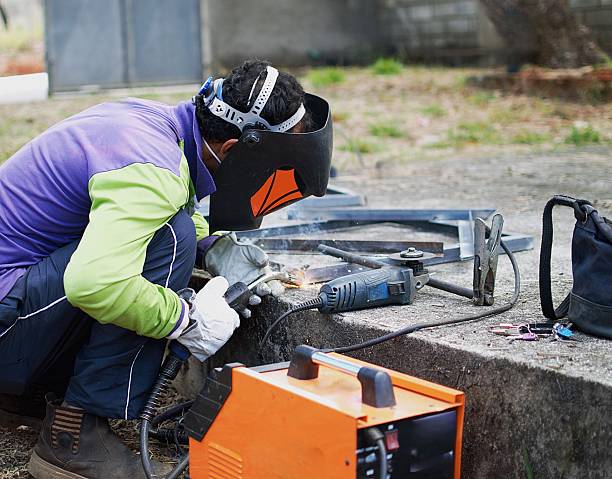
The very nature of welding arcs determines their high risk to the eyes.
Welding arcs are plasma discharge phenomena formed at extremely high temperatures and energy densities. While producing intense visible light, they also release large amounts of ultraviolet and infrared radiation. The combined effect of these three types of radiation poses a multiple threat to the human eye, and the most dangerous component is often not the one people perceive immediately.
Visible light can be dazzling, but it is ultraviolet (UV) radiation that truly causes acute eye damage. UV radiation has high energy and strong penetrating power, capable of burning the cornea and conjunctiva in a short time. This type of damage often doesn’t cause immediate, severe pain, but rather manifests gradually over several hours—this is the most deceptive aspect of welding arc injuries.
Infrared radiation primarily has a thermal effect, which can have a chronic impact on the lens and retina. Even short periods of exposure during prolonged work in an infrared radiation environment can lead to blurred vision and decreased contrast sensitivity over many years. Once this damage occurs, it is almost impossible to reverse.
What do the eyes endure during welding without a welding helmet ?
The moment the electric arc is ignited, the brightness spikes to a level that the human eye cannot adapt to in an extremely short time. Normally, the human eye relies on pupil contraction to adjust the intensity of light entering the eye, but this physiological response takes time, while the brightness change of a welding arc is almost instantaneous.
Without a welding helmet , the eyes are directly exposed to high-intensity radiation without any buffer. Even a brief glance is enough to damage the surface cells of the cornea. This damage is not immediately noticeable, but it triggers an inflammatory response during cell repair, leading to typical photokeratitis.
Many welders experience this for the first time after get off work or at night, suddenly feeling stinging pain in their eyes, tearing, intense photophobia, and even being unable to open their eyes. This pain is not caused by external injury, but rather by a severe reaction to damage to the nerve endings in the cornea.
Photokeratitis is not a “minor problem”.
Photokeratitis is very common in the welding industry and is therefore often underestimated. Some people believe that it will get better with a few days of rest and will not leave any lasting effects. But in reality, every case of photokeratitis is a clear event of tissue damage.
While the cornea possesses a certain capacity for self-repair, frequent damage can reduce the quality of this repair. With increased exposure, the corneal surface may become less smooth, and tear film stability may decrease, leading to chronic dry eye, foreign body sensation, and eye strain. These problems may not be immediately apparent, but can severely impact work and quality of life years later.
Even more alarming is the potential for arc radiation to induce chronic conjunctivitis and pterygium. These conditions have been observed in individuals exposed to outdoor ultraviolet radiation, and the intensity of ultraviolet radiation from welding arcs is far higher than that in the natural environment.

not wearing a welding helmet for extended periods on eyesight are cumulative.
The eye damage caused by welding arcs is not a one-time event, but a typical cumulative injury. Many welders do not notice obvious problems early in their careers, but as their years of work increase, their vision often declines faster than their peers.
This decline doesn’t necessarily manifest as changes in nearsightedness or farsightedness, but rather as a weakened ability to adapt to changes in light, poorer night vision, and a decreased ability to distinguish details. These changes are often mistakenly attributed to natural aging, while the effects of long-term welding exposure are overlooked.
The chronic thermal effects of infrared radiation on the lens may also accelerate the development of lens opacity. Although the causes of cataracts are complex, prolonged exposure to high infrared radiation environments is undoubtedly a significant risk factor.
Why is the侥幸心理 (a sense of luck) that “it’s okay to just glance at it” the most dangerous?
In actual operations, the most common dangerous behavior is not completely neglecting protective gear, but rather intermittently looking at the arc with the naked eye. For example, confirming the position before igniting the arc, or taking convenience when doing short-term welding repairs. This behavior is dangerous because arc damage does not require prolonged exposure.
The damage caused by ultraviolet (UV) radiation to the cornea is dose-related, but the dose is not entirely dependent on the duration of exposure; it is also closely related to the intensity. The UV intensity of welding arcs is extremely high; even a fraction of a second of direct exposure can exceed the safety threshold.
Worse still, this brief exposure often occurs when one is caught off guard, with the pupils relatively dilated, allowing more radiation to enter the eye. This is why many people experience severe symptoms that very evening, even though they “only glanced at it.”
welding helmets fundamentally prevent these injuries?
a welding helmet is not to block out light, but to continuously and stably filter harmful radiation throughout the entire welding arc process. Even the most basic welding helmet has a filter that inherently blocks ultraviolet and infrared rays for extended periods.
In automatic light-changing helmets, this protection is further enhanced. Even in the instant before the light-changing process is complete, ultraviolet and infrared rays are still blocked by the filter layer, avoiding damage caused by momentary exposure. The darkening process is more about controlling the intensity of visible light and reducing eye strain, rather than assuming full protective responsibility.
When a welding helmet is worn correctly and kept in good condition, it effectively creates a stable physical barrier for the eyes, keeping the energy of the welding arc always outside a safe range.
In conclusion: Once eyesight is impaired, even the best welding skills become useless.
Welding is a job that relies heavily on visual precision, and eyesight is an extremely fragile and irreplaceable ability. The damage to the eyes from the welding arc often doesn’t cause immediate harm, but rather accumulates slowly through daily neglect.
When we truly understand what not wearing a welding helmet means, we realize that every time we look at an arc with the naked eye, we are trading our future vision for immediate convenience. A welding helmet is not a nuisance, but a prerequisite for the long-term, safe conduct of welding work.
Protecting your eyes is never about waiting until they hurt; it’s about preparing before each and every curve appears.