welding helmets is never just about “convenience”.
Many non-professional or novice welders believe that the differences between welding helmets are not complicated. They think that as long as it blocks light, it doesn’t make much difference whether they wear it or not, since welding time is short anyway. This seemingly reasonable judgment leads many to choose welding protective equipment based solely on price, appearance, or usage habits, neglecting the underlying protective logic differences between the various welding helmet structures.
In fact, handheld welding helmets, flip-top welding helmets, and automatic light-adjustable helmets are not simply a matter of “old” and “new” models, but rather three solutions that have evolved gradually under different technical conditions, usage environments, and operational needs. They each solve different problems, and their applicable scenarios do not completely overlap. Ignoring these differences and choosing based solely on intuition can easily expose safety hazards in actual welding operations.
Understanding the real differences between these three types of welding helmets is not just about choosing the one that’s most convenient, but also about finding the most reasonable and safest protection method for different welding tasks.

Handheld welding helmet: the most primitive and experience-dependent method of protection.
Handheld welding helmets are one of the earliest forms of welding protection. Their structure is very simple; essentially, they are protective masks with fixed filters, used by hand to block the arc light during welding.
The most distinctive feature of this type of welding helmet is that protection and operation rely entirely on the welder’s coordination. Before igniting the arc, the welding position must be confirmed, the helmet quickly moved to obscure the welder’s vision, and then welding can begin. The entire process demands a very high level of timing, skill, and hand-eye coordination.
In experienced welders working at a slower pace, a handheld welding helmet can provide basic protection. However, it offers virtually no margin for error. If there’s even a slight time lag between the arc’s activation and the shielding, the eyes can be directly exposed to arc radiation. Even a brief moment of exposure can cause UV damage.
Furthermore, holding the welding helmet occupies one hand, which is a serious limitation in many practical working conditions. During welding, welders often need to perform stable operations with both hands simultaneously. Holding the welding helmet not only increases the difficulty of operation but also easily leads to unstable posture, thereby increasing safety risks.
Therefore, handheld welding caps are more suitable for scenarios with low welding frequency, few weld points, and low requirements for precision and continuity, and are commonly used in simple repairs, temporary operations, or teaching demonstrations. They are not suitable for long-term or high-intensity welding, and are even less suitable as primary protective equipment for daily work.
Flip-top welding caps: a transitional solution between efficiency and protection
The flip-top welding cap was essentially developed to solve the problem of not having enough hands when using a handheld welding cap. It is fixed to the head via a headband structure, allowing the filter lens to be flipped up before welding to confirm the welding position, and then quickly lowered to begin work.
Compared to handheld welding helmets, flip-top welding helmets offer significantly improved operational stability. Both hands are free to be used for welding operations, eliminating the need for welders to perform high-risk coordination movements between arc application and shielding. From a safety perspective, this represents a significant advancement.
However, a significant problem remains with flip-top welding helmets: the timing of switching welding protection remains entirely in the hands of the welder. The flipping action must be completed before the arc is applied, but if the judgment is flawed or the action is delayed, the arc may still occur before the lens is fully lowered.
In practice, many welders develop a habit of using their peripheral vision to observe the welding position while flipping the cover. This behavior may seem harmless in the short term, but it repeatedly exposes the eyes to incomplete protection. In the long run, this intermittent exposure also carries cumulative risks.
Flip-top welding caps are more suitable for scenarios where precise welding position confirmation is crucial but the welding rhythm is relatively controllable, such as low- to medium-frequency structural welding or maintenance work. For applications requiring frequent arc ignition and continuous welding, their efficiency and safety gradually become insufficient.
Automatic light-adjustable helmet: Shifting protection from “human judgment” to a system-driven process.
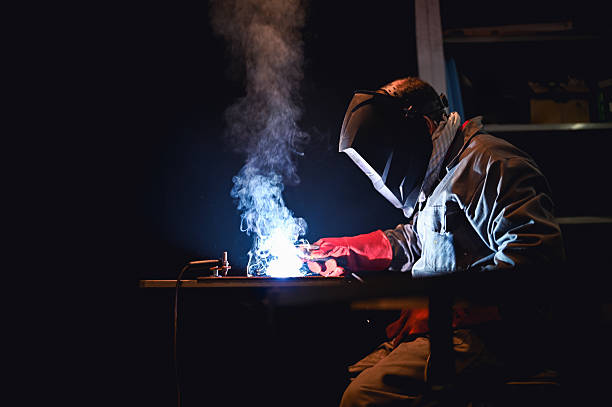
the automatic adjustable-lens welding helmet represents a significant shift in welding protection concepts. It eliminates the need for welders to make precise timing judgments before igniting the arc; instead, it uses a photosensitive system to automatically adjust the lens state the instant the arc appears.
In an automatic light-adjustable helmet, welders can complete pre-welding positioning and preparation in a relatively bright field of vision. When the electric arc is ignited, the photosensitive element quickly detects the light signal unique to welding, triggering the liquid crystal layer to change its transmittance and suppress visible light to a safe range.
The core significance of this process is not merely “saving time,” but rather minimizing the risks associated with human reaction time. The eyes no longer need to endure the intense stimulation of the instantaneous arc, and welding protection shifts from relying on experience to relying on a stable system response.
The advantages of automatic light-adjustable helmets are particularly evident during long-duration, high-frequency welding. Welders no longer need to repeatedly look up, flip the helmet, or adjust their posture, thus significantly reducing the burden on their visual system. This not only improves work efficiency but also plays a vital role in protecting eyesight during long-term use.
Of course, automatic light-adjustable helmets are not a “one-size-fits-all solution.” They place higher demands on the stability of the light-sensing system, the quality of the filter materials, and the overall structural reliability. If these basic conditions are insufficient, it may lead to problems such as false triggering or inconsistent protection.
The essential differences in protection logic among the three types of welding caps
From the perspective of protection logic, the biggest difference between handheld welding helmets, flip-top welding helmets, and automatic light-changing helmets is not in appearance or price, but in “who decides whether the protection is timely”.
Handheld welding helmets rely entirely on the welder’s reaction speed and experience; any mistake can directly impact their eyes. Flip-top welding helmets offer some structural assistance, but accurate judgment by the welder is still crucial in critical moments. Automatic light-adjustable helmets, through system response, free up the opportunity for protection from manual operation.
This is why the advantages of automatic light-adjustable helmets become more apparent when welding frequency is higher and work time is longer. It doesn’t make welders “lazy,” but rather reduces human error in high-risk environments.
Appropriate selection strategies for different use cases
In practical applications, no single welding helmet is suitable for all situations. The key is to select the most appropriate protection method based on the complexity of the welding task, its duration, and the precision requirements.
For occasional simple welding with few weld points and ample operating space, a handheld welding cap can meet basic needs, provided adequate protective measures are taken. However, it is not suitable for frequent or high-energy welding.
Flip-top welding caps still have some practical value in medium-frequency welding, especially when pre-welding observation is required but the welding rhythm is controllable. However, they are highly dependent on user habits, and risks remain if incorrect operating procedures are adopted.
Automatic light-adjustable helmets are more suitable for continuous welding, long-term work, or scenarios with high welding quality requirements. Their advantages are not only reflected in protection, but also in overall work efficiency and fatigue management.
In conclusion, choosing a welding helmet is essentially choosing a risk control method.
When we truly understand the differences between handheld welding helmets, flip-top welding helmets, and automatic light-changing helmets, we will find that this is not a simple “battle between the old and the new,” but a choice of risk control methods.
a welding helmet has never been to make welding “more convenient,” but rather to ensure that welders remain within a controllable range when facing the high-energy risk source of an electric arc. Different types of welding helmets simply provide varying degrees of risk management capabilities under different conditions.