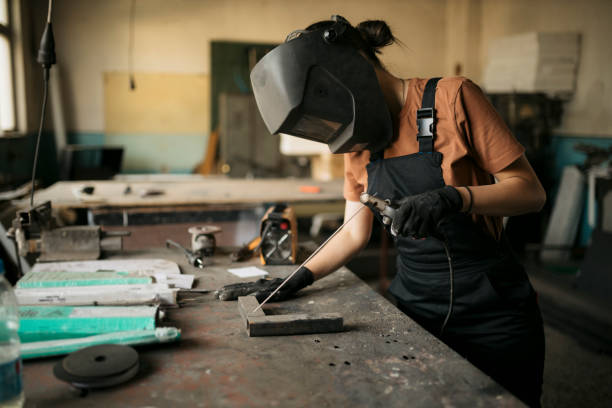
Welding is a high-intensity job that requires prolonged concentration. The welder’s visual experience directly impacts both work quality and safety. A welding helmet ‘s lenses must not only protect against glare but also ensure a clear and stable field of view under various lighting conditions. Optimizing visual comfort and clarity are paramount considerations in modern helmet design.
The importance of optical grade
Welding helmet lenses are typically graded according to optical standards, primarily based on clarity, light scattering, uniformity, and angle dependence. A high optical grade (e.g., 1/1/1/1) means the lens maintains consistent field of view quality at all angles, without blur or color shift. This is crucial for welders working long hours, as even slight visual deviations can affect weld accuracy or cause visual fatigue.

Automatic dimming and visual balance
Auto-dimming technology allows welders to maintain a continuous field of vision between light and dark transitions, but different models vary significantly in response speed and the smoothness of the transition. High-quality helmets dim within milliseconds of arc light onset and quickly return to clear vision after welding. Too fast or too slow a dimming time can cause visual discomfort and even temporary dizziness. Therefore, helmets with adjustable delay time and sensitivity allow welders to freely adjust the balance based on ambient light.
Field of view and light transmittance
a welding helmet also affects comfort. Traditional helmets have smaller viewing windows, while modern designs emphasize a panoramic view, allowing welders to easily capture changes in their surroundings. Larger lenses don’t necessarily mean brighter; the key lies in balanced light transmittance. High-quality lenses offer UV and infrared protection while maintaining natural color reproduction, enhancing the contrast between the weld seam, molten metal pool, and arc light, thereby reducing eye strain.
Anti-fog and anti-reflective treatment
Lenses can easily fog up during extended periods of welding or in humid environments, affecting visibility. Lenses with anti-fog coatings can effectively alleviate this problem, while ventilation systems or airflow guides can also help keep lenses dry. Furthermore, anti-reflective coatings can reduce glare from internal and external light sources, stabilizing vision and preventing misjudgments caused by light interference.
Small details to reduce visual fatigue
Visual fatigue is often not caused directly by glare, but rather by the constant switching between light and dark and unstable focus. Some high-end helmets utilize “natural color” technology. This optimized light filtering allows welders to see tones closer to the true metal color, rather than the monotonous green filter of traditional lenses. This natural visual experience can effectively relieve eye strain and improve concentration during long hours of work.
Conclusion
a welding helmet is more than just the brightness and darkness of the lens; it’s a comprehensive reflection of technology, ergonomics, and color perception. Choosing a helmet with excellent optical performance, a wide field of view, and natural colors not only allows welders to see more clearly, but also allows them to complete each weld more easily and safely. A truly excellent helmet not only protects the eyes but also maintains the welder’s focus and professional confidence.