Introduction: Many people underestimate the true value of welding helmets.
To many beginner welders, the purpose of a welding helmet seems very simple: to block the glare of the electric arc and prevent them from being “unable to see clearly” or “blinded.” This understanding is not wrong on the surface, but it is extremely one-sided. In fact, it is this perception of “just blocking the light” that leads to serious misunderstandings among welders regarding helmet selection, usage, and maintenance, directly causing problems such as eye damage, eye strain, and chronic vision loss.
The electric arc generated during welding is not merely bright; it’s a complex mixture of high-energy, multi-wavelength radiation, posing a far more complex threat to the human body than most people imagine. The welding helmet is an irreplaceable component of welding protection not because it’s “black,” but because it performs a systematic protective task, filtering, delaying, weakening, and stabilizing various hazardous factors. Understanding this is a prerequisite for the correct use of a welding helmet .
Electric arcs are not just sources of intense light; they are high-risk sources of complex radiation.
The welding arc releases extremely high intensity visible light at the moment it is generated, but this is only the most direct and easily noticeable part. The real long-term harm to the human body comes from the ultraviolet and infrared radiation hidden behind the visible light. Ultraviolet radiation directly damages the cornea and conjunctiva, a major cause of photokeratitis, while infrared radiation causes chronic thermal damage to the lens and retina.
Many welders first experience eye stinging, tearing, and photophobia several hours after finishing welding, which is a typical characteristic of UV damage. This delayed damage is highly deceptive, leading people to mistakenly believe it’s just “not getting enough rest,” while overlooking the fundamental cause: inadequate helmet protection.
If the purpose of a welding helmet is simply to block out light, then wearing dark lenses would suffice. However, the reality is that even with reduced brightness, ultraviolet and infrared rays can still penetrate substandard light-filtering systems, causing continuous and irreversible damage to eye tissues. This is precisely the most dangerous aspect of the “light-blocking” mindset.
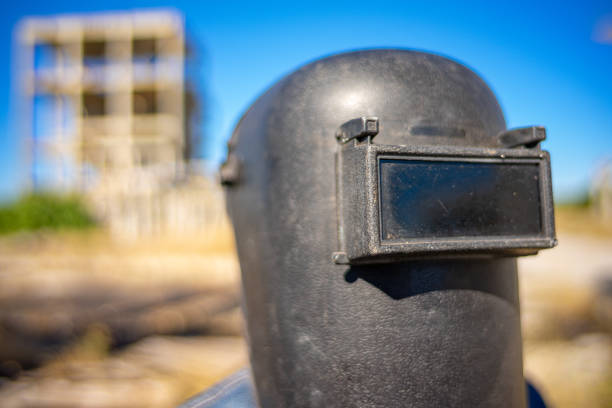
a welding helmet : full-spectrum filtration rather than just light blocking.
A truly qualified welding helmet must first and foremost provide protection across the entire spectrum. This means it must simultaneously filter and attenuate ultraviolet, infrared, and high-intensity visible light the moment the welding arc appears, rather than simply darkening the image.
In this layer of protection, the filter structure plays a decisive role. Even the most basic welding helmet uses multiple layers of materials in its fixed lens to achieve long-term blocking of harmful radiation. It is important to emphasize that this blocking does not depend on whether the lens darkens, but on the physical properties of the materials themselves. Therefore, even during the very short period when an automatic light-adjusting helmet has not yet darkened, the eyes are still protected.
This is why a proper welding helmet will not allow ultraviolet and infrared rays to shine directly into the eyes, even in bright light. Its protective logic is never “safe because you can’t see it,” but rather “no harm even if you can see it.”
Automatic light adjustment is not a gimmick, but rather a compensation for the limits of human visual reaction.
Many people’s understanding of automatic brightness-adjustable welding helmets is limited to “convenience” and “not needing to look up frequently,” but they overlook its true significance. The human eye’s physiological reaction speed to strong light is limited, while the brightness change of a welding arc occurs instantaneously. At the moment the arc ignites, the brightness can reach an extremely high peak in a very short time, a speed of change far exceeding the pupil’s ability to constrict and the visual adaptation.
The core value of an automatic dimming system lies in its ability to trigger a change in the liquid crystal layer through a photosensitive element the instant an electric arc appears, rapidly suppressing visible light to a safe range. This is not for the sake of “seeing clearly,” but rather to prevent the eye from being subjected to excessive stimulation at that moment.
When the welding helmet ‘s light-changing speed is insufficient, or when the light-sensitive area is blocked, welders may not experience obvious discomfort, but their eye tissues will still be gradually damaged by repeated, instantaneous stimulation. This type of damage is often difficult to detect in the short term, but will manifest years later as decreased vision and weakened night vision.
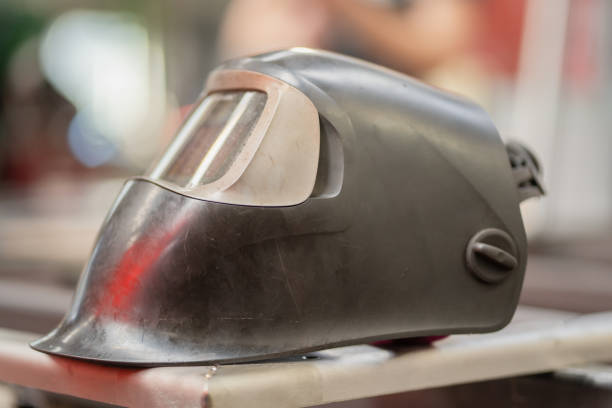
The core of the protection logic is not just the eyes.
a welding helmet is far broader than just “eye protection.” The welding arc releases radiation along with high-temperature spatter, metal vapor, and intense localized heat radiation. If these factors directly affect facial skin, they can also cause chronic damage.
People who are exposed to welding arcs for extended periods without proper facial protection often experience accelerated skin aging, pigmentation, and even localized burns. This is why professional welding helmets typically feature full-face coverage, rather than just a light-filtering area around the eyes. The goal is to create a stable and continuous protective barrier between the welding area and the body.
From this perspective, a welding helmet is more like a personal protective system than a single pair of “glasses.” Through its structural design, it isolates multiple risks at a safe distance simultaneously.
Why do some people still feel that wearing a helmet “hurts their eyes”?
In practical use, many people wonder why their eyes still feel uncomfortable after welding, even though they are wearing a welding helmet . This is often not because the welding helmet is “useless,” but because its protective logic has been compromised.
The most common problems arise from helmet fit and usage habits. If the helmet is not worn securely, light leaks during welding, even brief lateral exposure, can allow ultraviolet rays to directly irritate the eyes. Additionally, aging filters and protective lenses burned by welding slag will also weaken the overall protective effect.
Another easily overlooked situation is the presence of reflected light sources in the welding environment. Arc light doesn’t only come from directly in front; reflections from surrounding metal surfaces are equally harmful. If the helmet isn’t designed to effectively shield the sides and bottom, the eyes may still be unknowingly exposed to the light.
From a safety perspective, a welding helmet is not necessarily better the darker it is.
Many people believe that the darker the visor of a welding helmet , the stronger its protective capabilities. This perception is also flawed. Excessively reducing visible light does not enhance the filtering effect of ultraviolet and infrared rays. On the contrary, it may cause welders to unconsciously move closer to the arc area when they cannot see the weld seam, thus increasing the risk of exposure.
Truly effective protection involves providing sufficiently clear and stable visual information while ensuring that harmful radiation is adequately filtered out. Only when welders can clearly judge the state of the molten pool and changes in the weld can they maintain a safe distance and reduce unnecessary repeated arcing and exposure time.
This is why high-quality welding helmets emphasize optical clarity. It’s not about “looking high-end,” but about creating a virtuous cycle between protection and operational efficiency.
In conclusion: A welding helmet is a protective logic, not just a piece of black glass.
Returning to the initial question, is a welding helmet really just for “blocking light”? The answer is clearly no. It’s a systematic protective logic built around arc damage, from radiation filtering and instantaneous reaction to facial isolation; every detail is designed to protect the welder from risk.
When we truly understand the core value of a welding helmet , we realize that choosing and using it is essentially taking responsibility for long-term vision, skin health, and occupational safety. A welding helmet is not an accessory, but a crucial piece of equipment in the welding process that cannot be simplified or replaced.